Heardle Unlimited - Play the Ultimate Music Intro Game
Most music games give you the easy part first. HEARDLE UNLIMITED does the opposite. It gives you one tiny opening clip and asks, “Do you really know this song, or do you only know the chorus?”
That first second can feel unfair. A snare hit, a breath before a vocal, a weird synth buzz, or that little studio hiss before the beat drops. Then your brain starts digging through years of playlists without asking permission.
I’ve built word and guessing games long enough to know one thing: the best puzzles make people argue with themselves. Heardle Unlimited does exactly that. You guess, doubt it, skip, replay, smile, then wonder why one guitar note ruined your confidence.
What Is HEARDLE UNLIMITED?
Heardle Unlimited is a music intro guessing game where you listen to the opening seconds of a song and try to name the track and artist. The “Unlimited” part matters because you do not have to stop after one daily puzzle.
The classic Heardle idea works because it copies a feeling music fans already know. Someone plays three seconds of a song in the car, and one friend yells the answer before anyone else. Heardle Unlimited turns that tiny bragging-rights moment into a repeatable game.
You usually start with a very short clip, often the first second. If you know it, you type your guess. If your brain goes blank, you skip or guess wrong and unlock a little more audio. Six tries create the pressure.
That pressure gives the game its bite. You might recognize the beat but not the title. You might know the artist but forget the song name. You might hear the intro and swear it came from 2008, only to find out it dropped last year.
Why the First Second Feels So Hard
A song intro works like a fingerprint, but only when your brain has stored it clearly. Many listeners remember hooks, chorus lines, and music videos. Heardle Unlimited asks you to recognize the tiny part you probably ignored while reaching for your coffee.
That is why the game feels harder than a normal trivia quiz. A trivia question gives you words. A music clip gives you sound, mood, tempo, texture, and memory. Your answer comes from pattern recognition, not from reading a clue.
Research on music memory suggests people can recognize familiar songs from very short audio clips. Exact results vary by study, song familiarity, and listener background, but the idea tracks with real life. We know more music than we can name on command.
Here is the strange part: sometimes a longer clip makes you worse for a moment. The first second gives you one clear clue. The third or fourth second may introduce a vocal or beat that sends you toward the wrong decade.
That sounds backward, but actually, it happens often. Your brain grabs the nearest match. One dusty drum sound can make you think “90s hip-hop,” while the correct answer comes from a modern artist copying that style on purpose.
How Heardle Unlimited Works
The core loop stays simple because simple games travel best. You press play, hear the intro, search for a song or artist, and submit your guess. If you miss or skip, the game reveals more of the track.
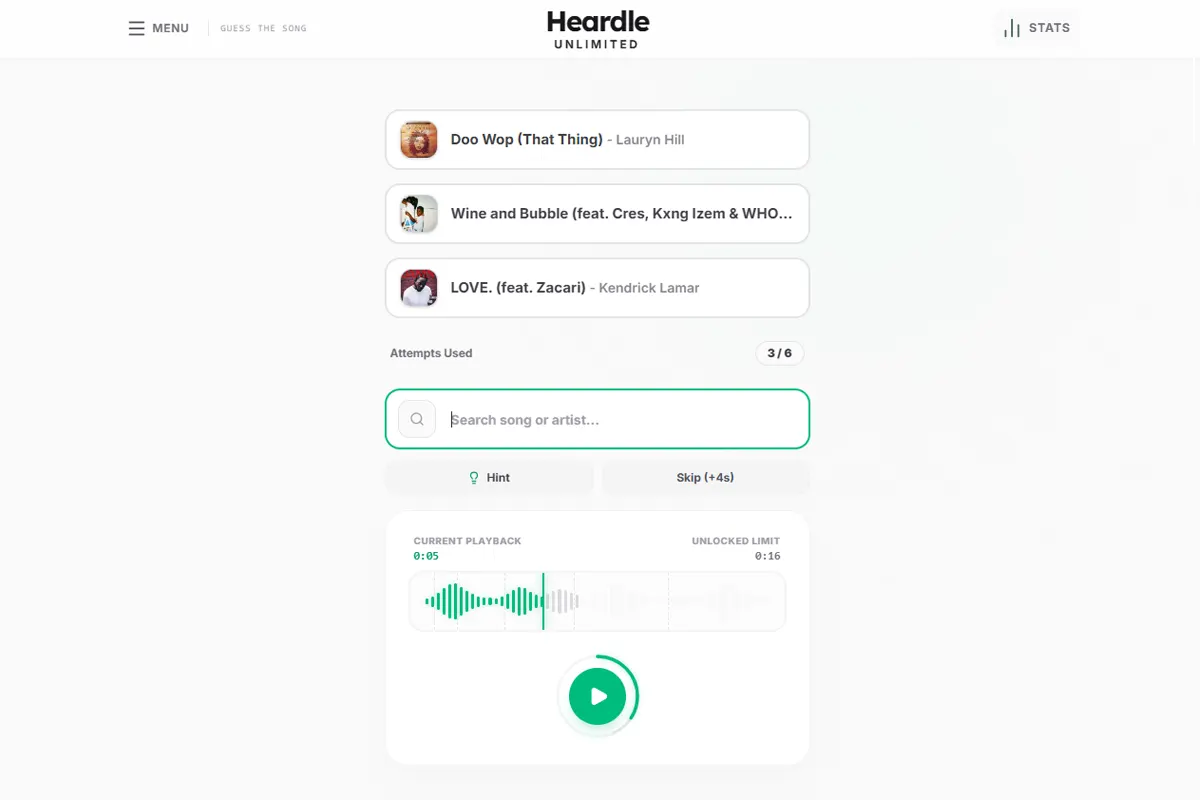
Most Heardle-style games give you six attempts. That number works well because it creates a natural story. Try one feels confident. Try two feels careful. Try three feels tense. By try five, you start hearing ghosts in the bassline.
The search box also changes the game. A good guess system must accept enough song names to feel fair without making the answer too easy. As a game maker, I care about that balance because bad search ruins good puzzles.
If the game includes genre or decade filters, those filters help you train your ear. Pop, rock, hip-hop, country, K-pop, anime music, video game music, and decade-based sets all push different listening habits. You learn the sound of an era.
HEARDLE UNLIMITED vs. Daily Heardle
Daily Heardle gives everyone the same puzzle for that day. That shared answer creates conversation. You can send your score to a friend and compare tries without spoiling the song. It has the same social spark that made daily word games explode.
Heardle Unlimited trades that shared daily moment for repeat play. You can keep going after one round. That suits people who want practice, comfort, or a quick music break that lasts longer than a single morning puzzle.
I like both formats, but for different moods. Daily mode feels like checking the weather. Unlimited mode feels like opening a record crate and pulling songs until one catches you. One gives routine. The other gives rhythm.
The risk with unlimited play is fatigue. After ten rounds, you may stop listening carefully and start guessing from habit. That does not make the game worse. It just means you should treat it like music practice, not a slot machine.
Why HEARDLE UNLIMITED Is So Addictive
The strongest hook is not the music itself. It is the almost-there feeling. You know you know the song. The title sits just outside reach, like a name you forgot while introducing someone at a party.
Games built around memory gaps can feel personal. A missed answer says nothing serious about your intelligence, yet it still stings. You replay the clip because your brain promises it can solve the puzzle with one more listen.
That emotional loop works better with songs than with facts. Music attaches itself to places. A school bus. A first phone. A gym speaker that sounded terrible but still played the same chorus every Friday.
Heardle Unlimited also gives you tiny wins. Even when you lose, you may discover a track you forgot or never knew. That softens failure. A wrong answer can still send you to a playlist later, which makes the game feel useful.
Choose Tracks by Genre and Decade
You can make your unlimited mode feel more personal by choosing the music you like. Pick a genre if you want songs from a certain style, or choose a decade if you want tracks from a specific time period. This helps you play the kind of music you enjoy without wasting time.
Choose Your Favorite Music Genre
You can filter unlimited mode tracks by your favorite music style. Choose one genre, or go with a random mix if you want something different each time.
Random Collections: You can shuffle through all genres and eras for a fresh mix every time.
Pop & Modern: You get chart hits and fresh modern pop.
Examples: Taylor Swift, The Weeknd,
Ed Sheeran
Rock & Alternative: You can enjoy arena rock, indie sounds, and classic grunge.
Examples:
Queen, The Beatles, The Rolling Stones
Hip Hop & Rap: You get strong lyrics, fast flows, and high-energy beats.
Examples: Drake,
Kendrick Lamar, J. Cole
R&B, Soul & Classics: You can listen to smooth grooves, soul tracks, and retro
hits.
Examples: Michael Jackson, Prince, Stevie Wonder
Country: You get storytelling songs, acoustic sounds, and folk-style melodies.
Examples:
Morgan Wallen, Luke Combs, Chris Stapleton
Electronic & Dance: You can play EDM, synth-pop, and club-style tracks.
Examples: Calvin
Harris, David Guetta, Avicii
K-Pop: You get Korean pop songs with catchy hooks and high energy.
Examples: BTS,
BLACKPINK, TWICE
Latin: You can enjoy reggaeton rhythms and passionate pop beats.
Examples: Bad Bunny, J
Balvin, Karol G
Jazz & Blues: You get smooth jazz standards and soulful blues sounds.
Examples: Miles
Davis, John Coltrane, Louis Armstrong
Classical: You can listen to orchestral music and timeless classical pieces.
Examples:
Ludwig van Beethoven, Wolfgang Amadeus Mozart
Pick Tracks from Your Favorite Decade
You can filter unlimited mode tracks by decade. This makes it easy for you to enjoy songs from the years you like most.
All Decades & Years: You can enjoy tracks from every generation with a wide mix of music.
2020s: You get fresh pop songs and trending viral hits from the current era.
Examples:
Taylor Swift, The Weeknd, Billie Eilish
2010s: You can play streaming-era hits, synth-pop, and big radio songs.
Examples: Adele,
Bruno Mars, Rihanna
2000s: You get millennial pop, boybands, hip-hop, and dance hits.
Examples: Britney Spears,
Beyoncé, Shakira
1990s: You can enjoy grunge, pop divas, and classic R&B.
Examples: Nirvana, Michael
Jackson, Mariah Carey
1980s: You get neon synth sounds, rock stars, and dance tracks.
Examples: Michael Jackson,
Madonna, Prince
1970s: You can listen to disco hits and classic arena rock.
Examples: ABBA, Queen,
Fleetwood Mac
The Best Way to Play Without Wasting Guesses
The mistake most players make is guessing too fast. One second feels urgent, but the game usually lets you replay the clip. Use that. Put your finger down, listen again, and notice what actually plays before typing anything.
Focus on the first clear sound. Is it a drum machine, live guitar, piano chord, vocal breath, crowd noise, synth pad, or bass hit? That opening texture often tells you more than melody, especially in hip-hop, pop, and rock.
Now compare the clip to a real shelf in your head. Does it sound like radio pop, album rock, club music, country, K-pop, Disney, anime, or video game music? Narrowing the style helps before you chase names.
Use skips with intent. A skip should answer a question, not replace thinking. If you need the vocal tone, skip once. If you need the beat pattern, skip once. If you have no clue at all, save guesses and listen longer.
A Simple Six-Try Strategy
This is the one list I would give any new player, because it keeps you calm when the timer in your head starts yelling. Try it for five rounds and you will notice fewer wild guesses.
- Try 1: Replay the first clip twice and name the decade or genre before guessing.
- Try 2: Search only if you can hear a clear artist clue.
- Try 3: Skip for melody, not panic.
- Try 4: Test your strongest title memory.
- Try 5: Think of similar artists and common hits.
- Try 6: Trust the most familiar answer, even if you cannot explain it.
That last try feels messy, but instinct can help. Your brain often recognizes a production style before it gives you words. If one answer keeps coming back, choose it over the clever guess you invented five seconds ago.
Genre Filters Make the Game Smarter
Genre filters do more than make Heardle Unlimited easier. They teach you what music communities actually sound like. Rock intros often lean on guitar tone. Hip-hop intros may start with drums, samples, tags, or spoken texture.
Pop can trick you because production styles repeat across years. A bright synth and tight kick might point to the 2010s, but many 2020s songs borrow that same shine. Country often gives you acoustic color, vocal entry, or pedal steel hints.
K-pop Heardle-style games add another layer because many songs shift style quickly. The first second may sound like electronic pop, then the next section flips into rap or a huge chorus. You need to catch arrangement choices early.
Video game music and anime songs reward a different memory. Players may remember a menu screen, a boss fight, or an opening sequence more than the song title. That makes the clue emotional before it becomes factual.
Decade Modes Turn Heardle Into Music History
Decade modes work because every era leaves fingerprints. A 70s track may carry warm drums, live room sound, funk guitar, or disco strings. An 80s song might open with gated drums, glossy synths, or a bassline that practically wears sunglasses.
The 90s bring their own clues: grunge guitars, boom-bap drums, R&B smoothness, dance-pop keys, and alternative rock textures. A 2000s clip may sound compressed, shiny, or ringtone-era bright. The 2010s often bring festival builds and polished pop drops.
These are broad patterns, not laws. Plenty of modern artists copy older sounds, and plenty of older records sounded ahead of their time. That is where Heardle Unlimited becomes more than guessing. It trains you to hear production choices.
If you want to get better, play one decade for a full session instead of jumping around. Your ear starts sorting sounds faster. After fifteen minutes of 80s tracks, a modern snare pretending to be 80s suddenly sounds different.
Artist-Specific Heardle Games Are Built for Superfans
Artist-specific versions work because fans store songs differently. A casual listener remembers singles. A superfan remembers album cuts, tour intros, leaked snippets, and the exact way a singer inhales before a line. That sounds dramatic until it happens to you.
Taylor Swift, BTS, Drake, Lana Del Rey, Harry Styles, Billie Eilish, Ariana Grande, Kanye West, Tyler, the Creator, Weezer, and many other fan communities have supported Heardle-style games. Availability can change, so always check the current site before assuming one exists.
These versions reward deep listening. If you only know the biggest hits, you may struggle fast. If you know album sequencing, production eras, and collaboration habits, you can spot a song from a drum fill or keyboard tone.
Artist games also create friendly chaos. Fans argue over whether an intro was too easy, too obscure, or unfair because the clip started before the “real” song began. As a developer, I love that complaint. It means people care.
What Makes a Fair Music Guessing Game
A fair music game needs more than a fun idea. It needs clean audio, a clear answer database, reasonable spelling tolerance, and a search system that does not punish normal human memory. People remember “Beyonce” without the accent, and games should understand that.
The game should also avoid tricking players with poor clip starts. Some songs have silence, long fades, skits, or crowd noise before the actual music begins. Those can be fun once in a while, but too many make players feel cheated.
Licensing matters too. Music rights can get complicated, and Heardle-style sites may change over time because of availability, platform rules, or takedowns. If a version disappears, that does not always mean the creator abandoned it. Sometimes the music access changed.
Trustworthy games explain how they work. They make sharing easy without spoiling answers. They track stats clearly. They keep the interface light. The best ones respect your time, because a five-minute music game should not feel like filing a form.
Stats, Streaks, and Why They Matter
Stats can either motivate players or bully them. A win percentage, current streak, best streak, and guess distribution can help you see real progress. The key is showing data in a way that feels helpful, not judgmental.
Guess distribution tells the best story. If you often solve on try five, your recognition works, but you need more confidence earlier. If you miss after wild first guesses, your issue is patience. Stats show habits you may not notice.
Streaks bring emotion. They make a daily puzzle sticky because people protect streaks like tiny pets. One missed day feels silly and painful at the same time. That little pang keeps players coming back, but designers should never abuse it.
For Heardle Unlimited, I prefer session stats over pressure-heavy streaks. Tell me how many I solved today, which genres beat me, and where I guessed fastest. That feedback helps me improve without turning music into homework.
Smart Hints Can Help Without Spoiling the Song
Hints work best when they nudge, not answer. Artist initials can help if you already hear the style. A cryptic clue can point toward a lyric, era, album theme, or cultural moment without handing you the title.
A bad hint ruins the puzzle. If it says “This 2015 pop hit topped charts,” the game becomes a search task. If it says “A late-night apology dressed as a dance track,” you still need to listen.
Good hint design respects the player’s pride. People do not want charity. They want a fair second angle. That is why the best hint arrives after a few attempts, when the player has already worked for it.
Heardle Unlimited can use hints especially well because players may meet unfamiliar tracks. A clue can turn a total miss into a learning moment. You leave with a song name, an artist fact, and maybe a reason to listen again.
Sharing Results Without Spoiling the Fun
A good share card should show attempts, skips, and success without naming the song. That lets friends compare skill while keeping the puzzle alive. The best sharing systems create curiosity, not spoilers. Nobody likes opening a group chat and losing the answer.
Challenge links add another layer. If I solve a track in two tries, I want to send that exact puzzle to a friend who claims they know “every 90s song.” The brag only works when both players face the same clip.
Sharing also turns solo listening into a social ritual. You do not need a leaderboard with strangers. One friend who sends a smug three-square result can pull you back into the game faster than any notification.
Still, spoiler manners matter. If you post the answer openly, you break the central pleasure. Share your score first. Save the title talk for later. Let someone else have that tiny “wait, I know this” moment.
HEARDLE UNLIMITED for New Music Discovery
The secret gift of Heardle Unlimited is discovery. You arrive to prove what you know, then leave with songs you do not. That shift matters. A guessing game can become a listening habit if it treats wrong answers kindly.
Music apps often recommend songs based on what you already play. A Heardle-style game can surprise you from another angle. It may throw an old Motown track, a Disney song, a metal intro, or a video game theme into your day.
Not every track will stick. That is fine. The point is contact. Even a ten-second clip can remind you that music history is bigger than your saved library. Sometimes the best result is not a win. It is a new tab.
If you play with genre filters, give yourself one wild round after your comfort zone. Try country if you avoid it. Try anime if you never watch it. Try 70s if your playlists start in 2005. Your ear needs strange rooms.
Common Mistakes Players Make
The first mistake is treating every intro like a chorus. Many songs do not reveal their identity right away. They build slowly. If you demand instant recognition, you will miss tracks you actually know once the vocal arrives.
The second mistake is typing the first familiar title. Familiar does not mean correct. Many producers use similar drum packs, chord progressions, and studio tricks. Slow down and ask whether the clip truly matches the song in your head.
The third mistake is ignoring silence and texture. A tiny vinyl crackle, count-in, crowd cheer, or producer tag can carry the answer. I once watched someone miss a song because they talked over the half-second tag that gave it away.
The fourth mistake is playing angry. It sounds funny, but it matters. When frustration takes over, you stop hearing details. Take ten seconds. Replay once. Breathe. Music games reward attention more than speed.
Is Heardle Unlimited Good for Parties and Classrooms?
For parties, yes, if you choose the right mode. Mixed groups need broad song pools or decade filters everyone understands. A room full of cousins may love 2000s pop. A room full of musicians may prefer obscure rock or funk.
Use teams for bigger groups. One person controls playback and guesses, while teammates shout suggestions. That setup creates noise, laughter, and ridiculous confidence. Someone will always say “I know this” with no answer ready. Every group has that person.
For classrooms, Heardle-style play can support music appreciation, media studies, or cultural history when teachers handle rights and access properly. Short clips can start conversations about genre, production, memory, and how sound marks a time period.
Keep it inclusive. Do not shame students for not knowing older songs or global hits. The goal should be listening skills, not proving taste. When used well, the game can make students notice music details they usually skip.
FAQ About HEARDLE UNLIMITED
What is Heardle Unlimited?
Heardle Unlimited is a music intro guessing game where you hear short clips and try to name the song and artist. Unlike a single daily puzzle, unlimited play lets you keep guessing new tracks across different styles, decades, or themed categories.
How many guesses do you get in Heardle Unlimited?
Most Heardle-style games give you six tries. Each wrong guess or skip usually unlocks more of the song. The exact timing can vary by version, but the six-attempt structure works because it gives pressure without making the puzzle feel impossible.
Can Heardle Unlimited help me find new music?
Yes, it can. You may start by testing your memory, but the game often introduces songs outside your normal playlists. Genre and decade modes make discovery easier because they place unfamiliar tracks beside sounds you already understand.
Is Heardle Unlimited only for pop music?
No. Many Heardle-style versions focus on rock, hip-hop, country, K-pop, metal, anime music, video game music, Disney songs, musicals, and specific decades. Availability can change, so check the current game options before looking for a favorite theme.
What is the best strategy for winning more rounds?
Replay the clip before guessing, identify the genre or decade first, and use skips to answer specific questions. Do not throw away early guesses on half-memories. Most players improve when they slow down and listen for texture, not just melody.
Why One Second of Music Still Wins
A great puzzle does not need much space. Heardle proves that with one second of audio and one stubborn memory gap. The format works because it turns listening into a small test of identity: what do you really know?
As a game creator, I judge music puzzles by one question: do players want one more round after losing? Heardle Unlimited passes that test because failure still gives you sound, memory, and sometimes a song worth saving.
The best way to enjoy it is simple. Play carefully, share kindly, and let yourself be surprised. HEARDLE UNLIMITED is not only about naming songs faster. It is about hearing familiar music like it still has secrets.